Three Tools for Healthy Relationships: Boundaries, Compassion and Detachment
Humans are relational animals. We rely on our connections to others to grow, learn, heal, and to survive! We have lots of different relationships, and they serve different purposes. I like to think of different relationships as helping to fill different buckets: romance bucket, friendship bucket, physical touch bucket, career bucket, fun bucket, learning bucket, etc. But how we do relationships greatly impacts the quality of those connections and the experience we end up having. Many of us learned relationship dynamics that have left us struggling, or wanting something better.
Here are some examples:
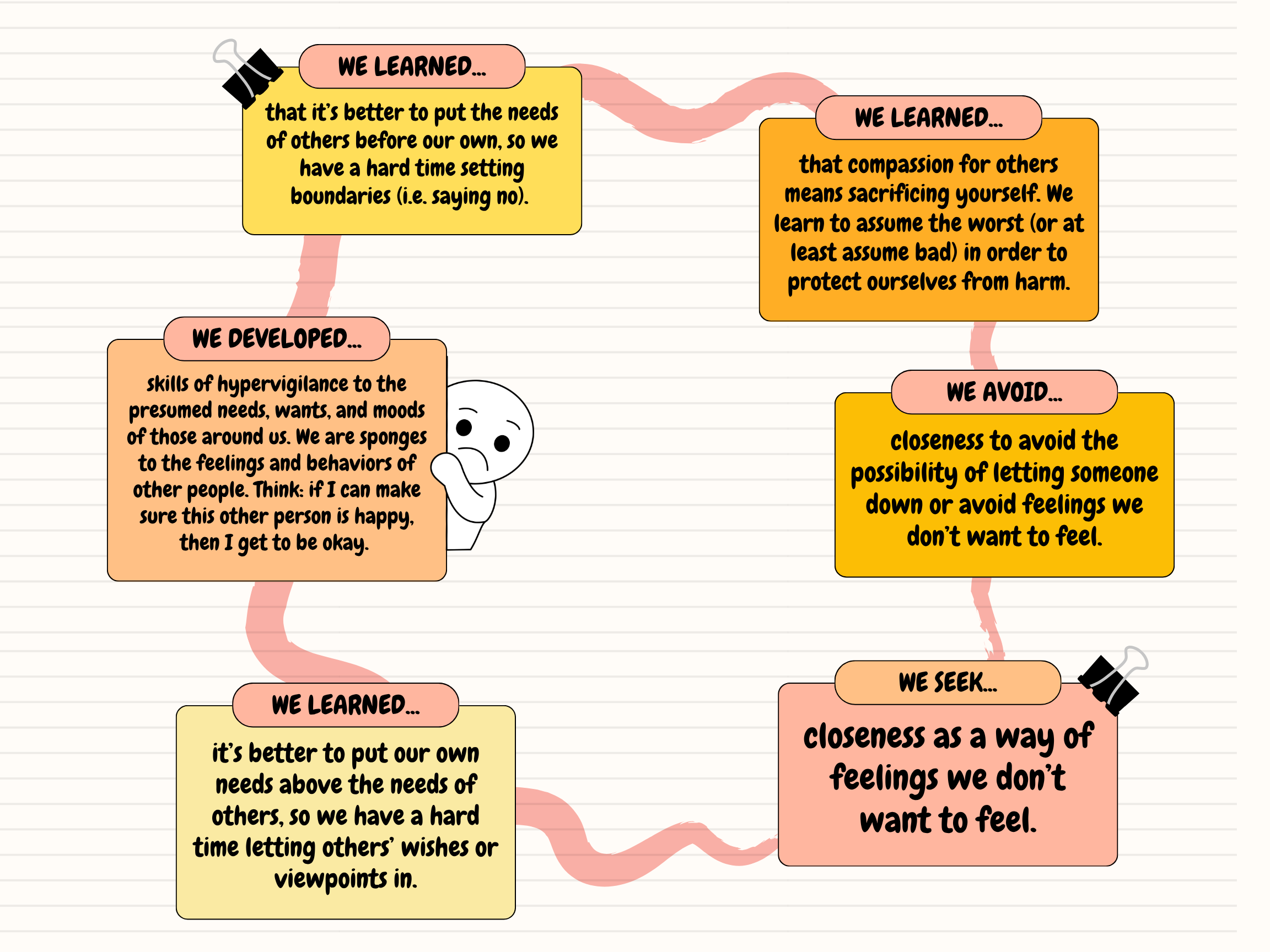
I work with clients to learn three components to healthy, caring, and nurturing relationships:
BOUNDARIES
COMPASSION
DETACHMENT
BOUNDARIES include internal boundaries and external limits. An internal boundary is the system inside of us that helps us decide what we want to keep in, and what we want to let out. An external limit is the practice of identifying what you are willing to do (or not willing to do), and communicating those limits. Example: I will invite family to stay at my house for a maximum of two nights at a time. Boundaries serve to prevent feelings of resentment or bitterness, and allow us to honor what we have to give.
COMPASSION is the practice of assuming that each person is doing the best the can with what they have in the moment, no matter how baffling their best is to us! It is a way of seeing the humanity in each of us, including ourselves. Compassion is the practice of honoring that a person always has reason for their actions, and we can never fully know what is under the surface for them. Example: Someone cuts you on the highway and drives speedily away; you can assume that there is reason for their actions (maybe they are headed to the hospital for their child’s birth; maybe they never learned to deal with anxiety or frustration).
DETACHMENT is the practice of acknowledging that the emotions and behaviors of other people to belong to them. This process is done internally – we are giving ourselves permission to set down responsibility for what others are putting out into the world. I have heard it put this way: “There is an emotion in the room, but I do not have to own it.” Detachment allows us to prioritize our own needs and honor whatever boundaries we have set for ourselves. Detachment also prevents us from taking personally the behaviors of others. Example: I let my family members know they are welcome to stay for two nights. Their reaction tells me that they are frustrated and think I should invite them to stay for longer. I can detach from their reaction and my story about them; they are entitled to their feelings. But their feelings are theirs, not mine.
While these skills might sound simple, that does not make them easy! Many of us have long-existing coping mechanisms that tell us to do the opposite of what I’ve written above. So we start small and slow. Just like learning a new language, we cannot flip a switch and be fluent! We learn to set and maintain boundaries, be compassionate, or practice detachment one little palabra at a time.
Check out our 3-part blog series on How to Set Boundaries here: