Overwhelm Series - Part 1
Have you ever felt overwhelmed? Check one:
Yes (I’m human)
No (I am AI / a robot / a figment of your imagination)
We all feel overwhelmed sometimes! Thankfully, we don’t have to stay overwhelmed. There are lots of ways to catch overwhelm, respond to it, and move through it. We’ll talk about those in this series on overwhelm.
Overwhelm has lots of different ways of showing up in our minds and bodies.
Sometimes, it looks like anxiety, feeling nervous or keyed up about something that just seems like too much. We can feel tense, or like we’re not enough, or not up to a task, and it all just feels like too much..
Other times, overwhelm can look like depression, a collapse, lack of energy, shutting down, feeling indifferent or apathetic, or getting paralyzed.
In the midst of overwhelm, it’s common to move toward distractions (“I’ll just scroll on my phone for a little bit…”), engage in negative self-talk (“what’s myproblem?!”), or feel self-critical or a sense of low self-worth (“I’m just lazy”).
The Size and Shape of Overwhelm
The amount of overwhelm we feel can be small or big, from, “I’ve got a bit too much on my plate right now,” all the way to, “I can’t go on anymore.”
The things we feel overwhelmed about can be small or big, and the amount of control we have can be small or big. The size of the task or event and the amount of control we have combine like this:
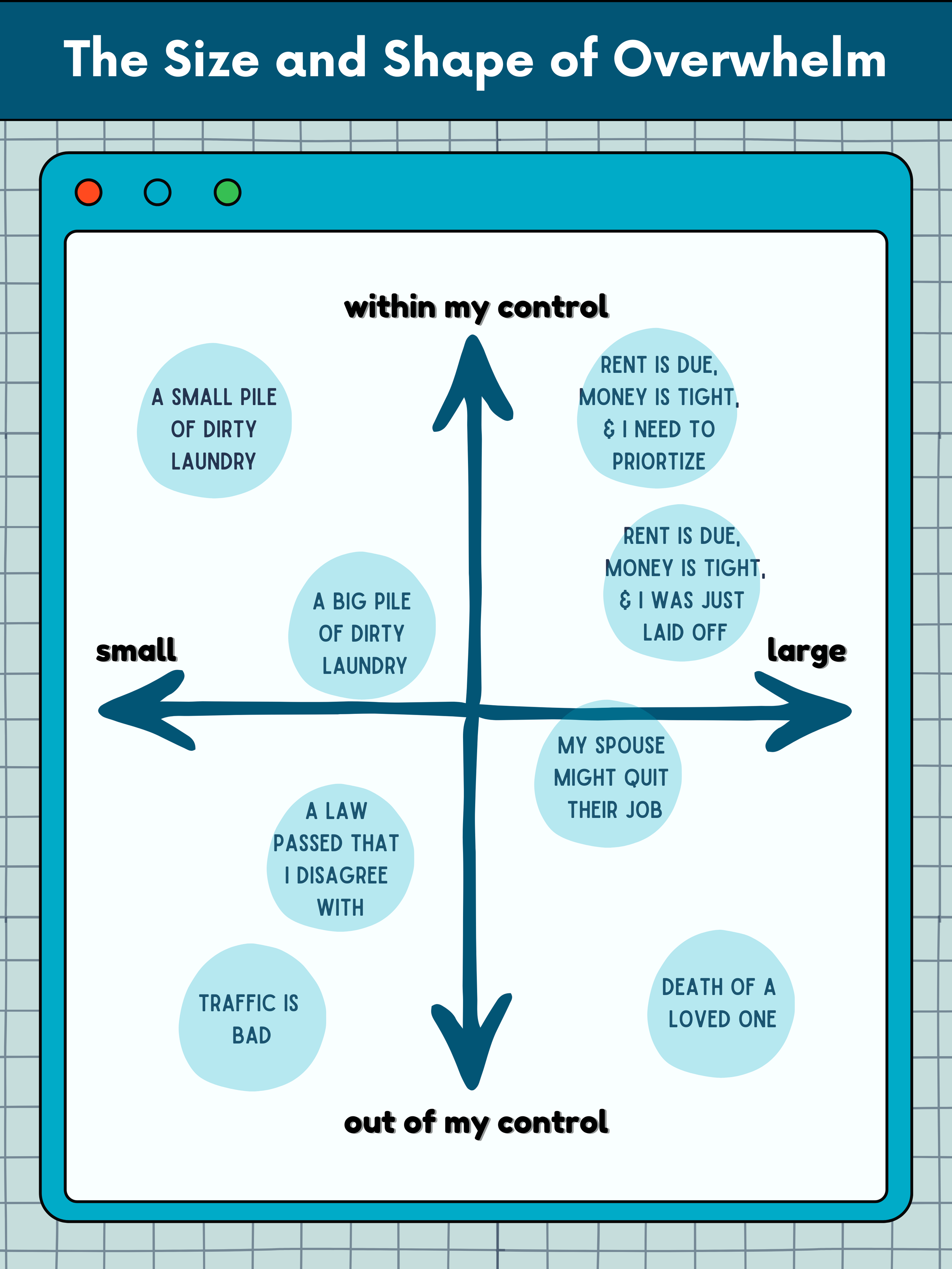
The responses we have to the overwhelm can be small or big, from a big sigh before starting taxes, all the way to considering or attempting suicide.
The Truth and Mythology of Overwhelm
Overwhelm happens when our focus is on the entire problem all at once. With the whole problem in scope, two things happen:
The problem takes up the whole frame - it seems huge and all-encompassing. Instead of seeing a whole prairie in a camera lens, we’re zoomed in on a single flower petal. It’s all we can see.
It seems like our actions won’t be able to tackle that entire size and shape.
That’s true!
The truth of overwhelm is that we can’t solve most problems in the split second of time it takes us to feel overwhelmed about them; the myth is that we should!
Most problems aren’t solved in a single instant, or in a single step. We need time and small steps to solve problems. When overwhelm is present, that truth is not obvious.
Imagine you need to fix something on a rooftop, and picture yourself standing on the ground, not able to reach the roof from where you stand.
It doesn’t take long to think of using a ladder, right?
When we’re relaxed, focused, and thinking clearly, breaking a big task into smaller steps is obvious.
Anxious and depressed and distracted experiences during overwhelm can easily get in the way of that clear thinking, though, and that makes it hard to build a sequence of steps we can climb, like rungs of a ladder, to get where we need to go.
But it’s still possible to build the ladder! We just need to slow down a little bit, and build it intentionally.
The first step toward change is noticing, which gets easier and more automatic with practice.
You could try paying attention throughout a day or a week to the times when you start to feel an anxious flutter in your belly or chest, or hear a defeating thought inside, like, “Yeah, right,” or, “I’m never going to be financially stable.”
When you notice those first indications of overwhelm, you can take a moment to label it: “Oh, that’s a bit of overwhelm,” and show yourself some compassion, like, “That makes sense. I’ve had a lot going on lately.”
Sometimes, that step is enough to pop back into clear thinking, like, “This will take some time, but that’s okay. I will figure it out. I’ve figured out tough things before,” and even take a moment to remind yourself of one of those tough things you’ve figured out. You might find yourself breathing easier right away, and sometimes that’s enough to move through the overwhelm!
Sometimes we need a little more support to move through overwhelm, so we’ll talk in subsequent posts about next steps to move through overwhelm, including:
Zooming out to make sure the overwhelm or the task or hardship are not the only things you can see;
Making it smaller - breaking the challenge up into smaller pieces so you can take on one reasonable piece at a time, with compassion.