Overwhelm Series - Part 3
Make it smaller
If it feels overwhelming, the next step just isn’t small enough yet.
In the first two Overwhelm articles, we talked about the size and shape of overwhelm - what it feels like, how it arises, and things that help in the moment, like noticing and naming it as overwhelm, connecting with your body to bring attention to your breath and body sensations, and then zooming out to remind yourself there’s more to life than this moment, which will pass.
Now let’s talk about making it smaller.
Making it smaller can help regardless of the size or shape of overwhelm we’re experiencing.
When we think of overwhelm as what happens when the next step just isn’t small enough yet, it becomes possible to zoom way in on the issue and choose one small piece of the thing that you can address.
When we make the next step smaller, it’s a reminder that we have some power and capacity, and we can use the power and capacity to decide a next tiny step we can take. This actually helps us stay zoomed out, so that we keep healthy perspective on the size and shape of overwhelm. When overwhelm is big, and we’re zoomed all the way in, those steps are blurry, and our power and capacity seem to have disappeared.
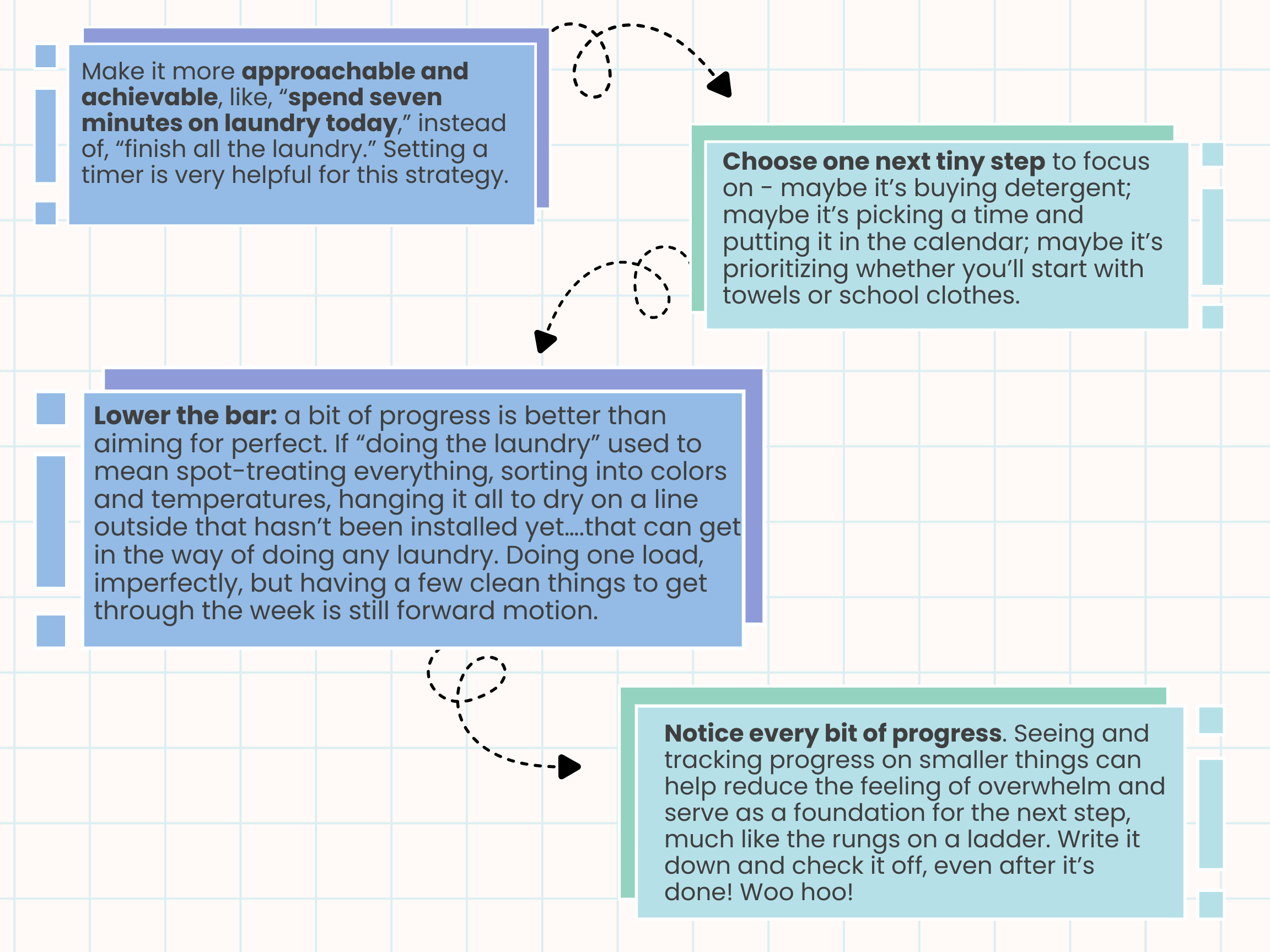
Making it smaller looks different in every application and setting, but let’s look at an example of making it smaller when overwhelm is mild, and the issue is within our control - like that pile of laundry.
When the laundry is piled up, the idea of finished laundry, with clean clothes all put away, might seem a million miles away. It can feel daunting to travel long distances, but it can be done when we take it one step at a time.
There are lots of ways to make it smaller:
Making it smaller isn’t just for concrete tasks.
If we stay zoomed out, thoughts can sometimes feel big, vague, or overwhelming. When the overwhelm is all around us, not just in our minds or our households, but in the news and our larger community, it can feel even harder to find some solid footing and know how to make it smaller, and where to even start.
Making it smaller can look like addressing one piece of your distress, or one piece of the problem. For example:
Name the feeling. Try to zoom in and name and acknowledge one emotion. Does your fear make sense? Is it understandable to feel some grief, anger, frustration, or confusion? Naming a feeling makes it easier to care for it.
Focus on one small action. Overwhelm can often feel like a loss of control. Focusing on one small thing you can do can have a massive impact on You don’t need to fix the whole system. Maybe it's making a donation or checking in on a friend. Reaching out to organizations in your community to volunteer or allowing yourself the time to rest so you don’t burn out.
Decide what intake is best for you. You could ask yourself, How much information am I absorbing? Is it helping me act in ways that matter to me, or am I just doomscrolling? What do I actually need to know and what am I just taking in? Creating boundaries so you can function sustainably is different from being uninformed; you’re just giving your nervous system a break, which helps you feel in charge again.
Check in with your body. Shimmy, shake or dance it out - recruit a kid or friend or enthusiastic labradoodle to goof around with you! Notice your breath and body. Lie down on the floor. Whatever helps bring you back to your body - it just takes a couple of minutes to benefit from the brain chemicals!
Phone a friend. Literally. Or talk to one face to face. Take an extra moment at the check-out counter to ask a real, “How’s your day?” question. Even low-level social interaction helps reduce stress and feel more connected to ourselves and to others.
Want a few more tips to help manage overwhelm?
We’ll spend 30 minutes offering some support for your mind, body, and heart, with a few concrete practices you can take away and use whenever you need them. There will be no video or audio for participants, so you can join anonymously. Your name will only be shared with us as hosts.
You can save the link by clicking the button below. We hope to see you there!